


BLYTHEWOOD – After two failed attempts in the last three months to adopt a new Freedom of Information policy that Media Attorney Jay Bender said included a number of provisions inconsistent with state law, Blythewood Town Council unanimously passed a resolution Monday night adopting a revised policy that would allow the Town to charge citizens as much as $86 per hour for a response to an FOI request.
That amount is down from the $225 per hour Town Attorney Pete Balthazor proposed for the town attorney to review FOIed records before release, even though such a charge for attorney review is not authorized under the state’s FOI Act.
Town Manager Doug Polen revised much of Balthazor’s initial proposals. However, several requirements remain in the revised version of the policy passed by council Monday night that do not appear to comply with state law.
The law requires governments to publish a schedule of fees that will be charged those persons submitting FOI requests. According to state law 30-4-30(B), “The public body shall develop a fee schedule to be posted online. The fee for the search, retrieval, or redaction of records shall not exceed the prorated hourly salary of the lowest paid employee who, in the reasonable discretion of the custodian of the records, has the necessary skill and training to perform the request.
The Town’s revised policy does not provide such a fee schedule. The only specific fee it lists is the cost per page ($0.25) for hard copies of records. The charge for staff time to search, retrieve, or redact records per hour is “TBD,” not a specific amount as required by state law.
The Town takes that a step further by charging an additional fee for an attendant [employee] to observe the FOI requestor as he/she reviews the documents requested. That charge exceeds what state law authorizes.
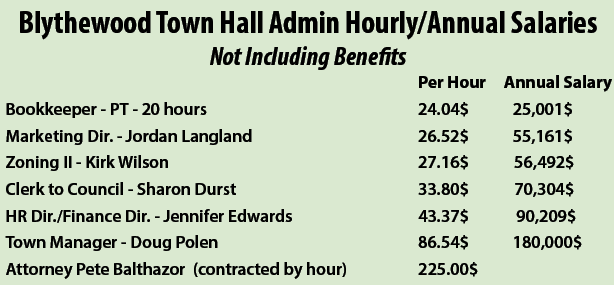
The Town’s marketing director, Jordan Langland, is the lowest paid full-time employee in town hall, at $26.52 per hour. She holds a Bachelor’s degree in Marketing from Clemson University, has two years’ experience with the Town and was named Business Person of the Year by the Blythewood Chamber of Commerce last year. But she is not the person in town hall designated as ‘qualified’ to print out emails and gather documents from all departments in response to FOI requests. Polen said several higher paid employees in town hall are the lowest paid employees who, in the reasonable discretion of the custodian of the records, have the necessary skill and training to perform the request.
In an email to The Voice, Polen stated: “The lowest paid qualified employee will almost always be Sharon Durst, as she is the FOIA official. She is [paid] $33.80 an hour. If it’s a planning question, it would be Kirk at $27.16. It could be me [at $86 per hour], but unlikely. I doubt there are files only I could get, unless I was pulling my own e-mails,” Polen wrote.
These costs are not disclosed in the Town’s FOI policy, leaving FOI requestors in the dark as to what their charges might be, and there is no indication in state law that the person who answers FOI requests is expected to be an expert in the subject matter of the department the FOI request pertains to.
The initial policy proposed by Balthazor in May mandated that no requestor could receive a waiver or reduced fee for FOI requests. The newly passed policy does not include Balthazor’s mandate, but it also does not mention that state law provides for waivers or reduced charges when information that is provided primarily benefits the general public. That provision is most relevant to newspapers and other media, but can apply to members of the public as well.
The new policy requires that a deposit be made by the requestor when the anticipated staff costs exceed $50. However, the policy does not mention that the deposit charge cannot, according to state law, be greater than 25 percent of the anticipated cost.
The state’s Freedom of Information Act establishes ceilings. It repeatedly frames these as maximums – reasonable fees not exceeding actual cost; hourly fees not exceeding the lowest qualified employee’s prorated salary; copy fees not exceeding prevailing commercial rates; and a deposit not exceeding 25 percent. The state FOI Act directs that records be furnished at the lowest possible cost.
The Town’s policy states that the “FOI official is authorized to and shall consult with the town attorney on non-routine FOI requests,” but does not define a ‘non-routine FOI request.’
The new policy went into effect Monday.