

As time passed, we began thinking about getting rid of the mobile home. Bill had always wanted to build a log cabin, so after thinking it through that is what we decided to do. We did have a lot of medium-sized pine trees. I have just recently realized that we could not build one now as the trees are too big and they would be impossible to handle.
Son Clark, an architect, safely away in New York City when the work started, drew plans for the foundation spacing and some renderings of what the cabin could look like with different roof lines and windows. I was wild to have a second floor and a gambrel roof. A patient I was working with at Friendship Center, an agency for recovering mentally ill, who was a carpenter, drew us plans for a gambrel roof that showed Bill how easy it was to construct.
Right off, Bill bought a tractor and a truck. Neither one did I think we needed, but he just looked at me and said “How do you think we are going to move logs out of the woods without a tractor?” I learned the truck was a necessity for foundation beams and later for windows and doors.
He seemed to know how to tie the trees so they would fall in the best direction. I pulled and he used the new power saw. After the first tree I learned to get out of the way! Surprisingly, the bark had to be skinned off of the trees pretty quickly so they would dry well. We invited the family to join in the fun, as we had read Tom Sawyer! All the children helped from time to time for this physical time consuming task. My mother and my two maiden aunts came and gave it a try. An uncle gave us my grandfather’s pull blade, but that was too hard for me to use. Bill stood and used an edger and I sat on the log and used a big butcher knife. We got a pile done for a start and covered them to dry.
Bill was a bit stymied for a while trying to figure out how to build a foundation. The pillars had to rest on a concrete pad four feet square and four inches thick. The trick was to make the tops come out even so the cabin floor would be even. I have no idea how he did it, but we have an even floor. He didn’t even know how to make cement.
Almost a year after we started, the first logs were ready to be placed and locked in. Moving them from their pile to the site was not easy. They were cut to length; the main room of the cabin was to be 30’ by 20’. Bill met me at one end with a wheelbarrow. He gave me a kiss and placed the end in the wheelbarrow. He grabbed the other end of the log and off we went. He gave me another kiss and placed my end of the log on the cement block, went to his end and placed it. That was basically how the logs were moved…I got a lot of kisses and calloused hands.
We used the saddle block method to connect the logs which meant you carve out the top of the first log, using a compass to measure the “saddle” for the next log to sit on. The next log is carved on the bottom, and so on. This leaves two inches or more for the insulation and the chinking, which makes the striking white strips in a finished cabin.
Stakes were placed through the logs to keep them stable. We used 1” square oak stakes that were 12” long, driving them into a 1” round hole drilled through two logs. Bill cut oak logs about 14” in diameter into 12” lengths. He scored them into 1” squares and, using a dogwood mallet and a big knife, I made the stakes. He drilled the holes through two logs that were locked together on their ends, and hammered in the stakes. Square peg in a round hole does the trick! I don’t think I got a single kiss for all those stakes.
As the log wall grew, Bill rigged a block and tackle to lift the logs in place. It was quite impressive to see him sitting on top of a ten foot wall lifting a thirty foot log with one hand. Putting in the windows and doors is a whole other story.
I can give you more details if you are planning on building a log cabin, but for now I will say that slowly our walls grew and five years later we had a log cabin. We must have done something right because thirty-seven years later it is still standing and is still making me a sturdy home full of memories.
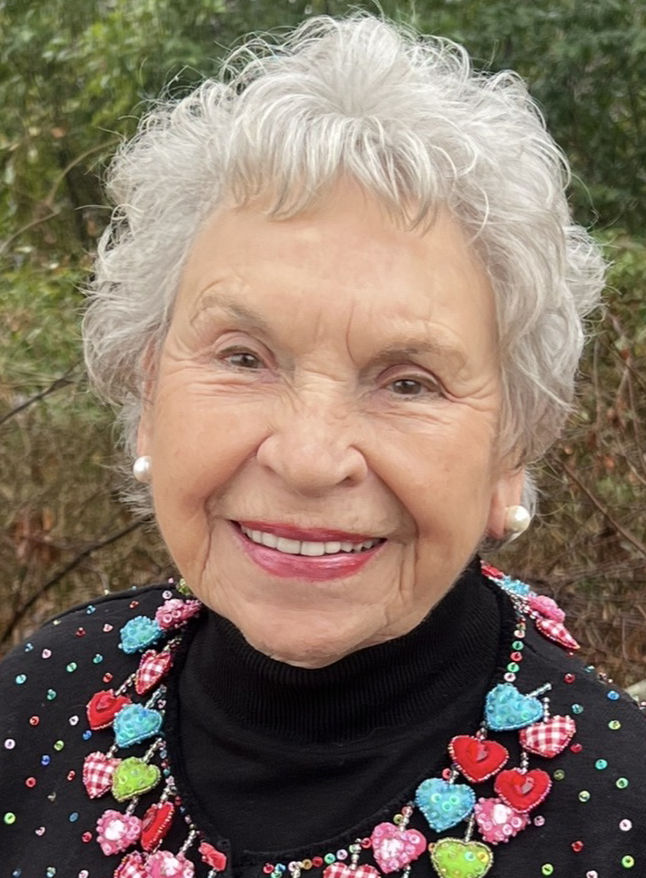
Jeanette Smith, 95, a Blythewood resident, has been active in the community’s civic affairs for over 50 years.