

BLYTHEWOOD – The history of the American Revolution is most often told through its battles, generals and military campaigns.
But Blythewood’s Arlene Andrews said that when she began her research, she wanted to know about the people who weren’t on the battlefield.
“Everybody wasn’t a fighter,” Andrews said. “I wanted to know how the ordinary people lived and survived.”
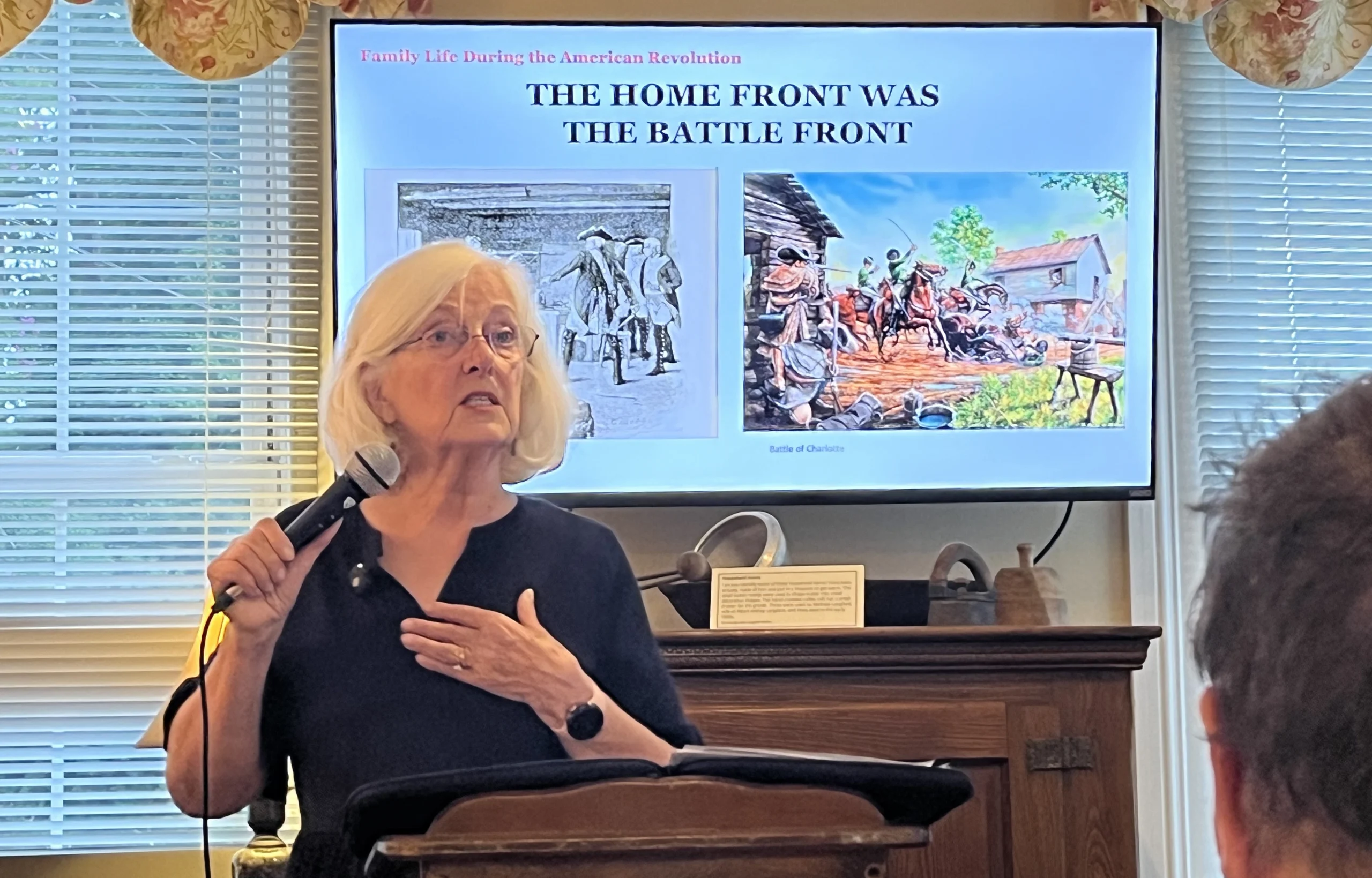
She answered that question Thursday evening at the Langford-Nord House as she presented the second of a five-part August lecture series on the American Revolution sponsored by the Blythewood Historical Society and the Nord Family Foundation.
Andrews, a retired University of South Carolina professor, directed family science research and co-founded USC’s Institute for Families and Society. A Blythewood resident for 30 years, Andrews said she is not a historian, but that her professional career studying families gave her a different lens through which to examine the Revolution.
The answer to her question was that family networks were crucial for backcountry families to both survive the war and, ultimately, for the Patriot cause to prevail in South Carolina’s backcountry.
Before the Revolution, Andrews said, European settlers in South Carolina’s backcountry generally lived on small farms, often 50 to 100 acres, separated by miles of wilderness and connected by rugged trails. There were few towns, roads, schools, courts or other government services.
Families settled near relatives whenever possible, creating tightly knit communities that provided security, labor and assistance.
They shared tools, helped each other build barns, harvested crops together and came to one another’s aid during illness, death, fire and other crises.
While those families appeared self-sufficient, Andrews said, they were actually highly dependent on one another.
“Humans were never really meant to live that way,” she said of the myth of complete self-reliance. “With rare exceptions, humans live in social networks.”
Central to the existence of families in a backcountry during the Revolutionary War era, is that everyone in the household worked.
Women were not simply “housewives,” Andrews said. They gave birth and cared for young children while also preparing food, tending animals, making medicines and clothing and performing other labor necessary to keep a family alive. These women also learned to shoot and defend the home while their men were away.
Men and boys hunted, trapped and fished, cleared and tended land, cared for larger animals, maintained shelters and made shoes and leather goods.
Children went to work early. Boys generally began working alongside their fathers at about 5 or 6 years old, and some were accompanying their fathers into military service by age 9 or 10.
Life for these backcountry families was precarious even before war arrived.
Drought, disease, crop failures, crime and violence threatened families, while childbirth and childhood mortality were high. Andrews said historians estimate as many as one in eight to 10 women died in childbirth and only about half of the children born to white settler families survived to age 5.
Those hardships, she said, produced families accustomed to enduring loss while continuing the daily work of survival.
Backcountry society also included Catawba and Cherokee people and enslaved people of African descent, Andrews said.
Unlike the large plantations of the Lowcountry, backcountry farms generally held relatively few enslaved people. Andrews said approximately one enslaved person lived in the backcountry for every nine European settlers, compared with about two enslaved people for every white person in the Lowcountry.
Enslaved people had no legal right to marry or maintain a household and could be separated through sale, Andrews said, but nevertheless worked to maintain family connections in every way possible.
For European settlers, owning land helped create a particularly strong attachment to home.
Many had come from Britain, Ireland and northern Europe where owning land had been beyond their reach. In South Carolina, they could own and work their own property.
That, Andrews said, helped shape the way many backcountry settlers eventually viewed the Revolution.
“Their fight was about home,” she said. “Specifically, the right to have a home and to stay in their home.”
When war finally reached the South Carolina backcountry, however, there was little distinction between military and civilian life.
“The battlefront was the home front,” Andrews said. “The home front was the battlefront.”
Battles and skirmishes were fought on private farms and plantations. Armies moving through the countryside needed enormous quantities of food and supplies, which they often took from local families.
Livestock, crops and other provisions were sometimes voluntarily supplied, but most often confiscated or stolen.
Families also lost the labor and protection of husbands, fathers and sons who went off to fight. Women and others remaining at home had to assume those responsibilities while living with uncertainty over whether their family members would even return.
Andrews said backcountry residents could not necessarily avoid the conflict by declaring themselves neutral.
As fighting spread and grew more intense, families were forced to decide whether to support the Patriots, remain loyal to Britain or attempt to stay out of the war. Those choices were often influenced by family relationships, neighbors, religion and immigration history.
This essentially resulted in a civil war in the backcountry, with Patriot and Loyalist neighbors sometimes turning violently against each other.
Families also bore much of the burden after the battles ended.
Wounded and dead soldiers could be left behind in yards, fields and woods. Local residents cared for the injured, helped feed prisoners and took in refugees fleeing fighting elsewhere. Soldiers who survived sometimes returned home with permanent disabilities requiring long-term care.
Much of that caregiving fell to the women.
The movement of troops and refugees into the backcountry strained the families’ already limited food supplies and increased the spread of disease. The marauding forces brought the threat of theft, violence and sexual assault.
Yet Andrews said it was the same network of family and community relationships that had allowed backcountry settlers to survive before the Revolution that helped sustain them through it.
“They stood their ground and fought for a sense of place,” she said. “Because for the first time, they had a sense of place. They had a home.”
And, Andres concluded, those family ties provided much of the resilience that eventually helped advance the Patriot cause.
“What they did for the war,” she said, “was done by families and for families.”