

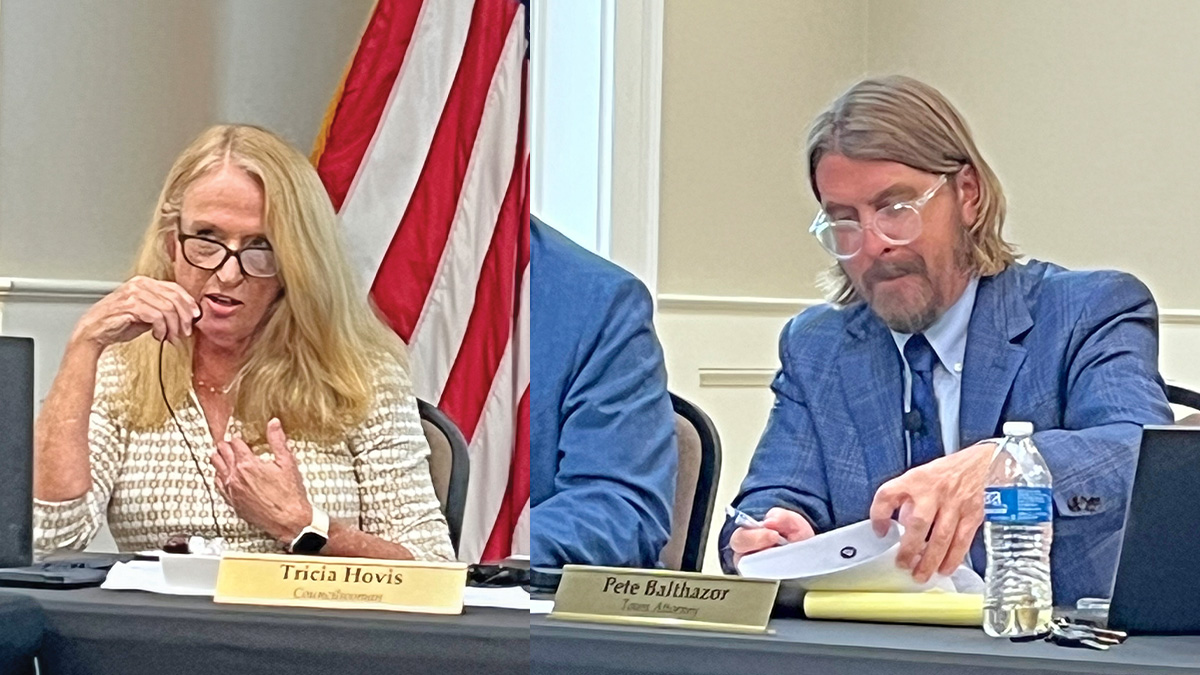
BLYTHEWOOD – The Blythewood Town Council unanimously voted Monday night to indefinitely table a Freedom of Information (FOI) policy proposed by Town Attorney Pete Balthazor after Councilwoman Tricia Hovis argued that some provisions in the policy did not comply with the S.C. Freedom of Information Act. Hovis said Balthazor’s proposal would also make it more difficult, expensive, and intimidating for citizens to obtain public records from Blythewood Town Hall.
The proposal, drafted by Balthazor, an attorney with Riley, Pope, and Laney law firm in Columbia, was brought before council as Resolution 2026-003. It had been presented as an ordinance at the previous two council meetings. Rather than voting on adoption Monday night, Hovis moved to amend the agenda to postpone consideration of the policy indefinitely. Council unanimously approved the motion without discussion.
After making the motion, Hovis outlined what she described as fundamental problems with the proposed policy.
“Overall, I believe it’s overly punitive and restrictive to our citizens,” Hovis said. “Not within the spirit with which the law was written, which is to give access to government, access to documents and make it easy.”
Hovis said she does not support frivolous public records requests but believes the proposed policy places an unreasonable burden on citizens by requiring highly detailed descriptions of the records they seek.
“The first part of the proposed document states that citizens need to provide specific descriptive information and have it be detailed,” she said. “That is a big ask. It’s also subjective.”
She said providing names, dates, topics or other identifying information when available is reasonable, but requiring extensive detail before a request could be processed is unnecessary.
Another concern involved allowing the town to pass along costs charged by third-party vendors hired to retrieve records.
Under the proposed policy, if town staff cannot retrieve requested records and outside assistance is required, those expenses could be billed to the person making the FOIA request.
“I don’t believe that’s necessary,” Hovis said. “The FOIA doesn’t address third-party vendors.”
She argued that citizens should not face significantly higher costs simply because a smaller municipality farms out search and retrieval to a vendor.
Hovis also objected to language that would allow the town to charge requesters for legal fees for the town attorney to review records before release.
Balthazor’s proposal for third-party costs and legal fees to be paid by the requester exceeds what the state FOI statute expressly authorizes. The state statute does not authorize a public body to pass through general third-party consulting fees or professional service charges because a government chooses to use outside vendors and lawyers.
Balthazor’s proposal stated that the Town’s FOI officer [town clerk] would be authorized to and shall consult with the town attorney on non-routine FOI requests and on any questions to determine if an exemption, restriction, or limitation applies and whether the Town should decline to disclose the records based upon the exemption, restriction, or limitation. There is no indication in the proposal as to what a non-routine FOI request would consist of.
Using outside counsel is permissible under state law; however, charging the requester for those legal services is problematic since it is not addressed in the S.C. statute. There is no language in 30-4-30 expressly authorizing recovery of outside vendor costs as a separate category of charges as Balthazor proposes.
“I don’t think that is permitted by the state FOI law,” Hovis said. “State law states that the costs for search and retrieval should be based on the hourly rate of the lowest-paid qualified employee capable of performing the work.”
Hovis also criticized a provision limiting the authority to waive FOI fees solely to requests that cost under $25 to respond to. The S.C. FOI statute does not contain a “$25 copying fee” threshold as created by Balthazor’s proposal.
“I don’t believe that we should be hamstrung and not be able to waive fees,” she said. “I think the council is perfectly capable of waiving a fee.”
Hovis noted that South Carolina’s FOI law allows records to be furnished without charge or at a reduced cost when appropriate. She said the town’s current policy already provides the flexibility to waive fees.
Finally, Hovis questioned language in the policy requiring anyone requesting records to sign a statement promising not to use the information for commercial solicitation.
She said state law already prohibits requestors from using certain public information for commercial solicitation and said adding a certification requirement unnecessarily burdens citizens.
“The warning is already in the law,” Hovis said. “We don’t need to further hamper the citizens by adding additional requirements that I believe are unnecessary.”
Balthazor’s proposed policy also fails to establish and publish a fee schedule as required by state FOI law.
He also notes with a double asterisk that “Actual third-party or legal costs may be charged only as permitted by S.C. Code 30-4-30.” But that code does not mention third-party or legal costs.
Before council members voted on Hovis’ motion to table the proposed policy, Councilman Rich McKenrick asked whether Hovis intended the measure to be postponed indefinitely rather than delayed until the next meeting.
“Indefinitely,” Hovis replied.
With no further discussion, council unanimously voted to postpone consideration of the proposed FOI policy indefinitely.
The action leaves the town’s current FOIA policy in place while council decides whether to revisit the proposal or pursue a different approach in the future.