

BLYTHEWOOD – After applicant Matthew Graham told members of the Blythewood Board of Architecture Review (BAR) that he would rather move his business into the former Wilson store in its current condition than bend to the Board’s renovation requirements that Graham said would cost him an extra $75,000, board members began discussing ways for the Town to find or raise funds that could be used for beautification of the town’s historic buildings.
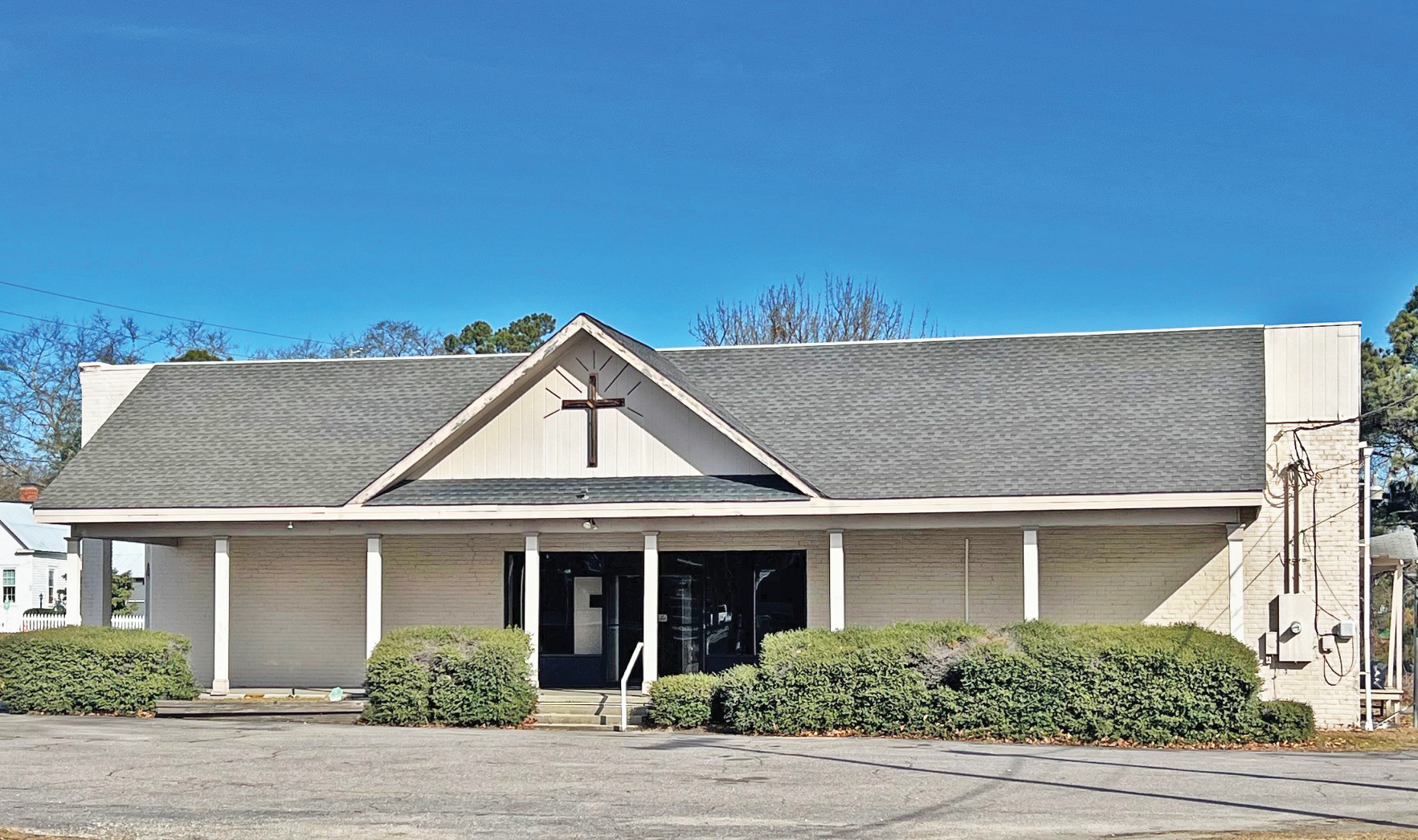
Graham appeared before the BAR Monday night seeking a certificate of appropriateness for exterior renovations to the Class II historic building, formerly known as the Wilson Store, which he purchased in December for approximately $550,000. His proposal included enclosing the building’s porch area with large, glass storefront-style windows, along an exterior painted white with black trim and black roof.
“Matthew, it looks awfully contemporary for a building that’s several hundred years old,” Board Chairman Paul Moscati told Graham.
Architectural consultant Ralph Walden agreed the proposal represented “a very contemporary architectural expression” and said the design did not successfully “marry the old with the new.”
Walden pointed to the building’s original arched windows and historic brick features and encouraged Graham to incorporate more of those architectural elements into the renovation.
“What we are looking at this point is a completely different architectural style on the parking lot side of the building,” Walden said. “There are potential things that could be done in that area.”
Board member Cindy Nord suggested that painting the building white with black trim just wasn’t quite right.

For almost an hour, the board chipped away at Graham’s rendition of his proposed renovation – the glass, the roofline, the square windows, the front, the side, the architectural style, and Graham’s chosen colors for paint and trim.
Graham asked members to clearly and exactly define what changes they wanted.
“My request is, just what is the ask from the BAR,” Graham told the board.
At one point, the discussion shifted into a debate over which side of the building should be considered the “front.” Graham maintained the historic Highway 21 façade remained the building’s true front because that had historically been its orientation for decades.
“I bought it with the understanding that the front of the building was the portion facing 21,” Graham said. “For 80 years it was the front.”
Board member Jim McLean argued that the new front of the building – the side of the building facing the parking lot – is the front. He argued that the building’s primary entrance had functionally shifted years ago when Highway 21altered access patterns. In the end, he acknowledged the historical argument that the front of the building faced Highway 21.
As the meeting progressed, board members began proposing modifications that would require restoring arched windows that had been squared off over the years with no pushback from the town government at the time. They also wanted Graham to add brick details and reduce the amount of glass in the design. As the Board added more and more modifications, Graham fed the design suggestions into AI on his laptop at the podium and emailed them to the Town’s Building and Zoning Analyst Kirk Wilson who then showed the designs on the overhead screen.
“Is this representative of what the ask is?” Graham asked after multiple redesign suggestions were discussed and shown on the screen. “The ask is to re-arch everything and to build arches on the front to mock, as closely as possible, the other arches that were originally there?”
Some board members nodded in agreement.
Board member Cindy Nord again questioned Graham’s proposed black-and-white color scheme. It’s too contemporary, Nord said, frowning toward the other board members. Graham pushed back, noting that similar colors already exist on the other nearby buildings.
“Every building around it is black and white,” Graham said. “Literally, every one of them.”
Eventually, Graham asked the board to split the certificate of appropriateness request into two separate parts — one for paint colors, decking and awning work, and another for the larger architectural renovations involving the windows and porch enclosure.
“If we can get a preliminary approval or a partial approval on the paint, that at least allows our team to keep moving,” Graham told the board.
In the first motion, the BAR voted 6 – 1 to approve Graham’s requested of “Tricorn Black” trim color and “High Reflective White” paint color, along with rebuilding the rear platform and deck area in an L-shaped configuration.
After the vote passed unanimously, Graham thanked the board.
“Excellent, thank you,” he said.
But as Moscati moved to make a second motion concerning renovation of the windows and porch enclosure, Graham stopped him to talk about the real cost to him of the board’s proposed approvals.
“We’re probably looking somewhere in the range of a $75,000 increase to go from stock windows that come off the shelf to custom storefront, custom brickwork, custom, custom, custom everything,” he said, referencing the board’s requirements for approval of the renovation.
Graham then asked whether the BAR had any ability to help offset those added costs.
“Would there be any interest from the BAR in contributing in any way to help?” he asked.
Board members became quiet, staring at Graham for several in unison seconds until Wilson spoke up, offering that the BAR had no funding authority.
With that, Graham withdrew the second half of his request.
“I’d like to withdraw the window renovations and the porch enclosure altogether,” Graham said. “I’m good with just the paint and the deck and the awning for now. We’ll circle back.”
The board’s tension escalated further only moments later when Graham explained the ramifications of the financial burden placed on him by the board renovation requirements.
“If you don’t want square (windows) and you want me to spend $75,000-ish to go custom, I’m not going to do it,” he said. “So, we can do square and make it look nice, or we can do it like a crappy old porch.”
Graham said he had not anticipated being asked to restore arches and redesign multiple windows when he arrived at the meeting.
“I didn’t know until I walked in today that I was going to be asked to update all the windows, update all the brick, arch everything out and go from all stock to all custom,” he said.
As the board recovered, Graham thanked them for approving the paint colors and exterior work.
“We’ll just paint it white and black,” Graham said. “But I do appreciate you all approving that. That’s an important part of our renovation.”
After Graham left, several board members who had levied the costly renovation requirements, acknowledged understanding Graham’s frustration and discussed whether the Town government should help find grant funding or preservation assistance for historic buildings undergoing restoration.
“He is over a barrel,” McLean said “We are asking him to do a lot to bring that building up to a historical standard. That is, I think, just a burden on him. I understand him being somewhat frustrated. I think this body has a right and obligation to tell the Town of Blythewood that this building is important enough to this body that they need to help seek funds to help him take that building back as best he can to historical standards.
“We threw the whole book at him in terms of what he needed to do,” McLean said.
McLean then made a motion to ask council to consider some way of providing funding for town beautification that might include historic restoration but was reminded that the item was not on the agenda. After a lengthy discussion of possible funding solutions, Wilson suggested that funding for historical properties be put on the next BAR agenda.
Council adjourned.
BAR’s requirements estimated over $100K
BLYTHEWOOD – The original design scope presented to the Blythewood Board of Architectural for renovation of the former Wilson Store was less than $25,000 in cost, according to applicant and store owner Matthew Graham.
“All materials were stock windows and doors, and all framing and siding was stock material.”
“After the BAR finished their proposed redesign the following improvements were imposed by the BAR,” Graham said.
Porch Enclosure and Exterior Window Restoration Scope
- Installation of 8 decorative brick column features to elegantly divide and highlight the arched styling of each window opening
- Construction of 6 new brick knee walls to provide structural definition and visual continuity along the porch enclosure
- Installation of Hardie siding above the gable and on the gable ends of the porch roof for enhanced durability and a clean, finished appearance
- Approximately 12–14 large arched glass panes installed across the front and sides of the porch enclosure, incorporating vertical dividers to ensure each individual pane is perfectly equal in size
- Fabrication and installation of custom arched storefront framing engineered to precisely receive and securely support the new arched glass panes while maintaining the historic character of the building
- Supply and installation of custom glass storefront doors specifically designed to complement the historic character of the building
- Complete re-bricking of all exterior windows around the full perimeter of the building to accurately restore their original arched styling consistent with the building’s historic construction
- Replacement of all existing windows with new custom arched glass units that closely match the original historic styling once the brick arches have been fully restored
- Application of a custom tint to all newly installed glass to ensure a uniform color, appearance, and energy performance across the entire project
- Repointing of all brickwork where the existing wall meets the new arch to create a seamless and smooth visual transition
“The total cost of all of these required additional scope items would bring the final renovation cost for the porch, window replacement, brick arches, knee walls, and all other added scope to well over $100,000,” said Graham.